Building a Performance Review Process That Actually Works
Let's be honest: most employees and managers dread performance reviews. The annual ritual of filling out forms, recalling accomplishments from 11 months ago, and sitting through awkward conversations serves neither the employee nor the organization. Yet performance management — done right — is one of the most powerful tools for developing talent, aligning goals, and retaining top performers.
Here is how to build a review process that people actually find valuable.
Why Traditional Reviews Fail
Before designing a better process, it is worth understanding why the traditional model is broken:
Recency bias — Annual reviews over-emphasize the last few weeks because that is what everyone remembers. An employee who performed brilliantly for 10 months but had one rough project in month 11 gets an unfairly negative review.
Halo effect — A single positive trait (e.g., "they are always available on Slack") colors the entire review, masking real areas for improvement.
Rater inconsistency — Different managers apply wildly different standards. A "meets expectations" from a tough manager may represent stronger performance than an "exceeds expectations" from an easy grader.
No follow-through — The review happens, the form is filed, and nothing changes. No development plan, no follow-up, no accountability.
Anxiety and defensiveness — When feedback is delivered only once a year, it feels high-stakes and personal. Employees brace for bad news rather than engaging constructively.
The Modern Approach: Continuous Feedback + Structured Reviews
The best organizations combine two elements:
Continuous feedback — Regular, informal check-ins between employees and managers. These are forward-looking, coaching-oriented, and low-stakes. They normalize giving and receiving feedback throughout the year.
Structured reviews — Formal assessment cycles (quarterly or annual) with defined competencies, rating scales, and multi-stage evaluations. These provide a documented record of performance for compensation, promotion, and development decisions.
The structured review is not eliminated — it is enhanced by the continuous feedback that precedes it. By the time the formal review happens, nothing should be a surprise.
Designing Your Review Cycle
Step 1: Choose Your Cadence
- Annual: One review per year. Works for stable organizations with clear, long-term goals. Risk: feedback is infrequent and can feel disconnected from day-to-day work.
- Semi-annual (recommended): Two reviews per year. Provides a mid-year checkpoint for course correction. Reduces recency bias compared to annual reviews.
- Quarterly: Four reviews per year. Best for fast-paced organizations, startups, and teams with rapidly evolving priorities. Can feel burdensome if the process is too heavy.
Step 2: Define Your Competencies
Competencies are the skills, behaviors, and values you evaluate. They should reflect what actually drives success in your organization. Common competency categories:
- Job-specific skills — Technical expertise, domain knowledge, role-specific capabilities.
- Collaboration and teamwork — How effectively the employee works with others.
- Communication — Clarity, frequency, and appropriateness of communication.
- Problem-solving — Analytical thinking, creativity, resourcefulness.
- Leadership — For managers: team development, decision-making, strategic thinking.
- Initiative and growth — Proactive learning, adaptability, going beyond assigned duties.
Limit yourself to 5–8 competencies. More than that and reviews become tedious and unfocused. Each competency should have a clear description so raters understand what "good" looks like.
Step 3: Set Your Rating Scale
A clear, consistent scale reduces rater inconsistency. Common approaches:
- 3-point scale: Needs Improvement / Meets Expectations / Exceeds Expectations. Simple and effective for smaller organizations.
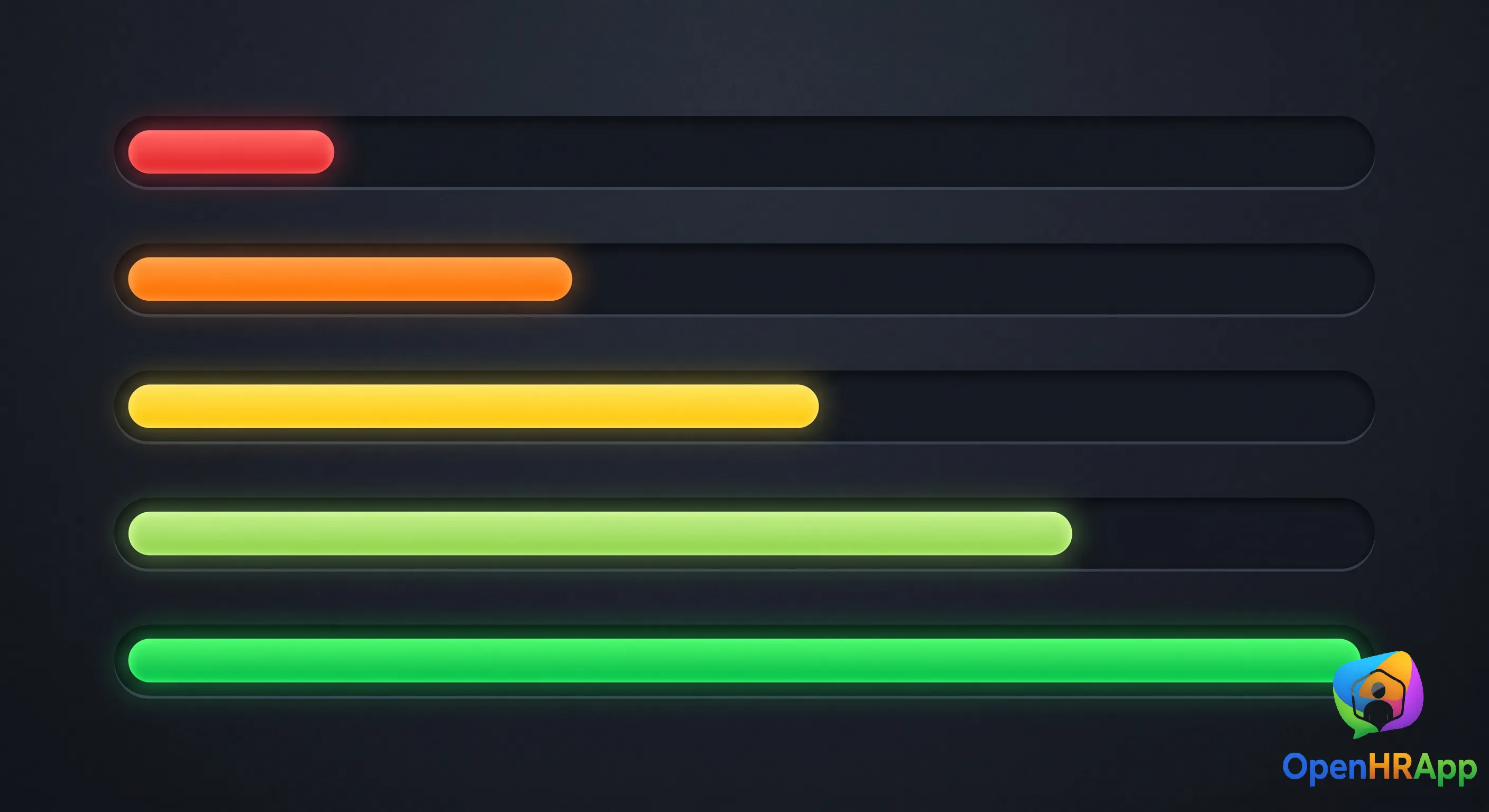
- 5-point scale: 1 (Needs Improvement) to 5 (Outstanding). Provides more granularity but requires clear definitions for each level to prevent everyone clustering at 3.
- Behaviorally Anchored Rating Scales (BARS): Each number on the scale is anchored to a specific, observable behavior. Example: Level 3 — "Responds to stakeholder requests within 24 hours." Level 5 — "Anticipates stakeholder needs and proactively provides solutions before requests are made."
The key is consistency: the same scale should be used across all competencies and all employees.
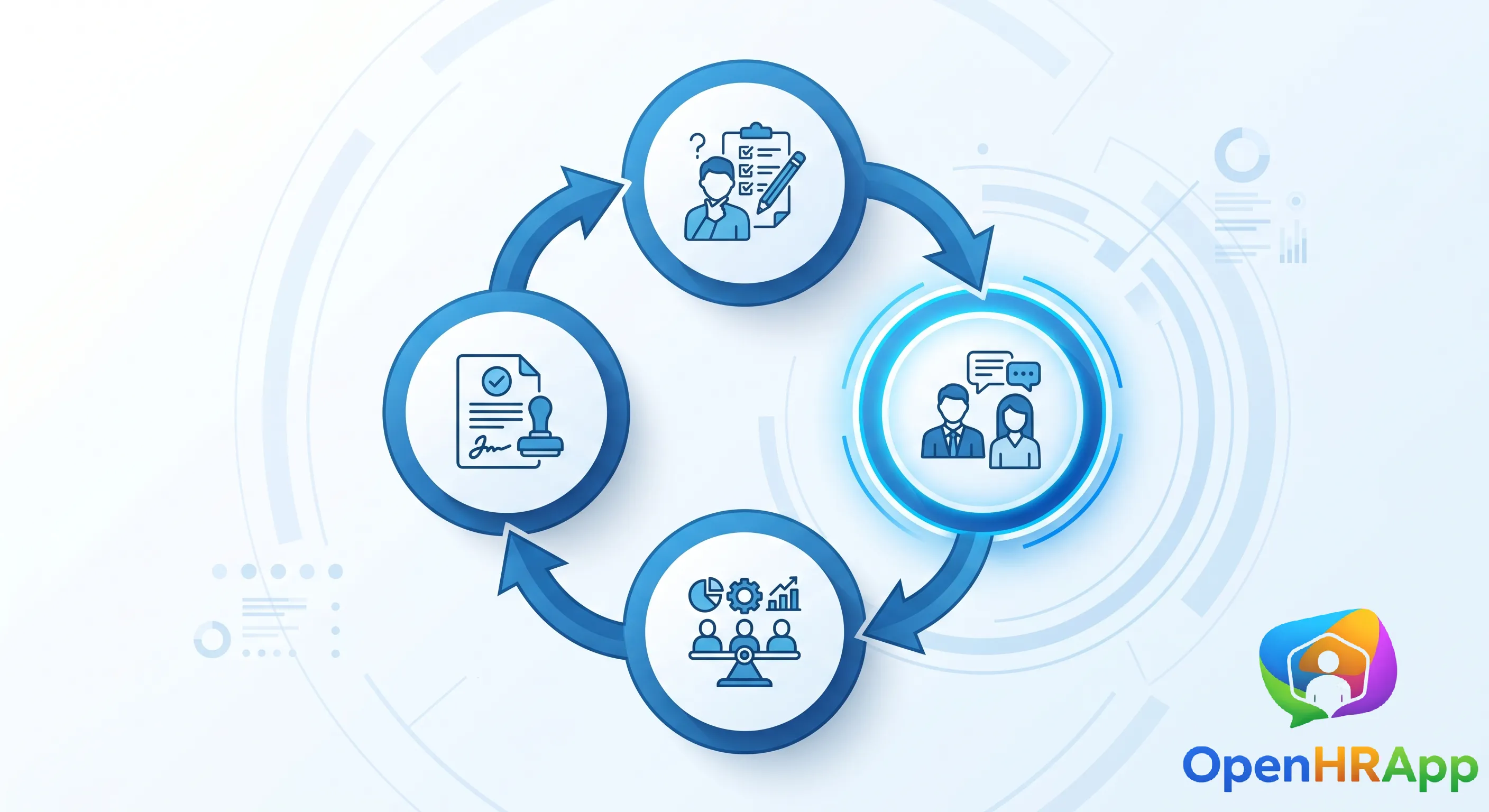
Step 4: Implement Multi-Stage Evaluation
The best review processes involve multiple perspectives:
Stage 1: Self-Assessment The employee rates themselves on each competency and provides written reflections. Self-assessments serve two purposes: they give the employee a voice in the process, and they reveal gaps between self-perception and manager perception — which is often the most valuable data point in the entire review.
Stage 2: Manager Evaluation The direct manager rates the employee on the same competencies, provides written feedback, and notes areas for development. This is the primary evaluation and carries the most weight.
Stage 3: HR Review and Calibration HR reviews all evaluations across the organization (or department) to ensure consistency. If one manager is rating everyone as "Outstanding" while another is more balanced, HR facilitates calibration discussions to align standards. HR then finalizes the reviews.
Optional: Peer Feedback 360-degree feedback — input from peers, direct reports, and cross-functional collaborators — provides a fuller picture. It works best in organizations with strong psychological safety where honest, constructive feedback is the norm.
Making Reviews Data-Driven
Effective reviews are anchored in evidence, not impressions. Integrate relevant data into the review:
- Attendance record — How many days absent or late during the review period? Is there a pattern?
- Leave utilization — Has the employee taken leave appropriately, or are they accumulating excessive unused leave (potential burnout risk)?
- Previous review scores — Has performance improved, declined, or stayed consistent across review cycles?
- Project outcomes — Specific deliverables, metrics, or milestones accomplished during the review period.
When this data is presented alongside the competency ratings, reviews become objective assessments rather than vague opinion exchanges.
Common Pitfalls and How to Avoid Them
The "Everyone is a 3" Problem
When managers rate everyone as average, the review process provides no useful differentiation. Fix this by: (a) training managers on what each rating level looks like with concrete examples, (b) requiring written justification for extreme ratings (both high and low), and (c) having HR facilitate calibration sessions.
The Halo/Horns Effect
When one outstanding (or terrible) trait colors the entire review. Fix this by requiring managers to rate each competency independently, with specific evidence for each rating.
The "No Surprises" Rule
If an employee is surprised by negative feedback in their formal review, the manager has failed at continuous feedback. Reviews should summarize and document what has already been discussed throughout the year.
Form Overload
If your review form takes more than 30 minutes to complete, it is too long. People will rush through it, and quality will suffer. Focus on what matters most.
Using Technology to Streamline Reviews
A good HR platform handles the administrative overhead so you can focus on the actual conversation:
- Automated cycle management — Define review periods, set deadlines, and the system tracks who has completed each stage.
- Competency templates — Create reusable competency frameworks that can be applied across review cycles.
- Data integration — Attendance and leave data is automatically pulled into the review, saving manual compilation.
- Progress tracking — HR can see at a glance which reviews are in draft, submitted, or completed.
- Reminder notifications — Automatic emails nudge employees and managers as deadlines approach.
See it in action: Our guide to OpenHRApp's Performance Review module walks through setting up review cycles, configuring competencies, and running multi-stage evaluations with the platform.
Conclusion
Performance reviews do not have to be an annual dread-fest. When designed thoughtfully — with clear competencies, consistent scales, multiple perspectives, and integrated data — they become a valuable tool for developing your people and aligning your organization. Pair them with continuous, informal feedback throughout the year, and you have a performance management system that actually works.
Further Reading
- A Guide to OpenHRApp's Performance Review Module — Step-by-step instructions for setting up and running review cycles in OpenHR.
OpenHRApp includes a full performance review module with customizable competencies, multi-stage evaluations, and integrated attendance/leave data. Start building better reviews — completely free.